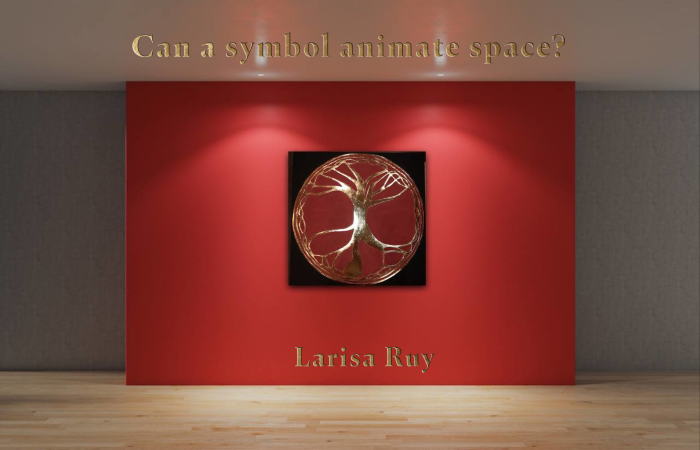
For many years, I’ve been working in my own direction — one that is most often associated with symbolism. Yet for me, it’s not so much a style as it is a language. A symbol is not a decoration or a riddle. It is an element that interacts with the viewer on a level where explanation is no longer needed.
But what happens when a symbolic image enters a specific space? A room with its own light, its own people, its own field? More and more, I notice how a painting — especially one created with intention — can shift the very energy of a place. Subtly. Not always obviously. But definitely not an illusion.
Eastern systems like feng shui or vastu have long described space as a living structure. They speak of energy flow, the direction of force, elemental balance. I never create a painting “according to feng shui,” but I can clearly sense how certain images intuitively find their rightful place. You don’t want to place a shark in the bedroom. A crow doesn’t belong in the kitchen. Butterflies won’t settle in the office. Some works carry movement. Others hold silence. Some open. Others close. And all of it is felt through the body — not through words.
What interests me is this: can we speak of art as an active element within an environment, not just as an image? Is it possible that a symbol in a work doesn’t just “mean something,” but truly interacts with the field — changing the quality of the air, the flow of thoughts, the state of a person?
This is not a statement. It is a question.
Because the more I create, the more I see: what matters is not only what is on the canvas, but where the canvas ends up.
How do you feel it?
Do you place the artwork where it looks beautiful — or where it feels right?
Larisa Ruy, 2025